
Medical Patient Follow Up Templates That Keep Care on Track

A medical patient follow up template should give staff a simple way to record what changed since the last visit and what happens next. Start with these fields:
- Visit date, reason, and relevant symptom changes
- Vital signs or other measures that show progress
- Treatment response, medication use, and any barriers
- Updated assessment, care plan, and follow-up date
The right checklist helps a busy practice capture key details without rewriting a patient’s full history. It also makes the next step clear to both staff and patients. The templates below cover routine visits, post-discharge calls, and patient-facing summaries.
I’m Matt Coffy, CEO of PatientEngines. For more than 15 years, I’ve worked in healthcare marketing and structured patient follow-up systems; this guide shows how a medical patient follow up template can fit into a more consistent patient journey.
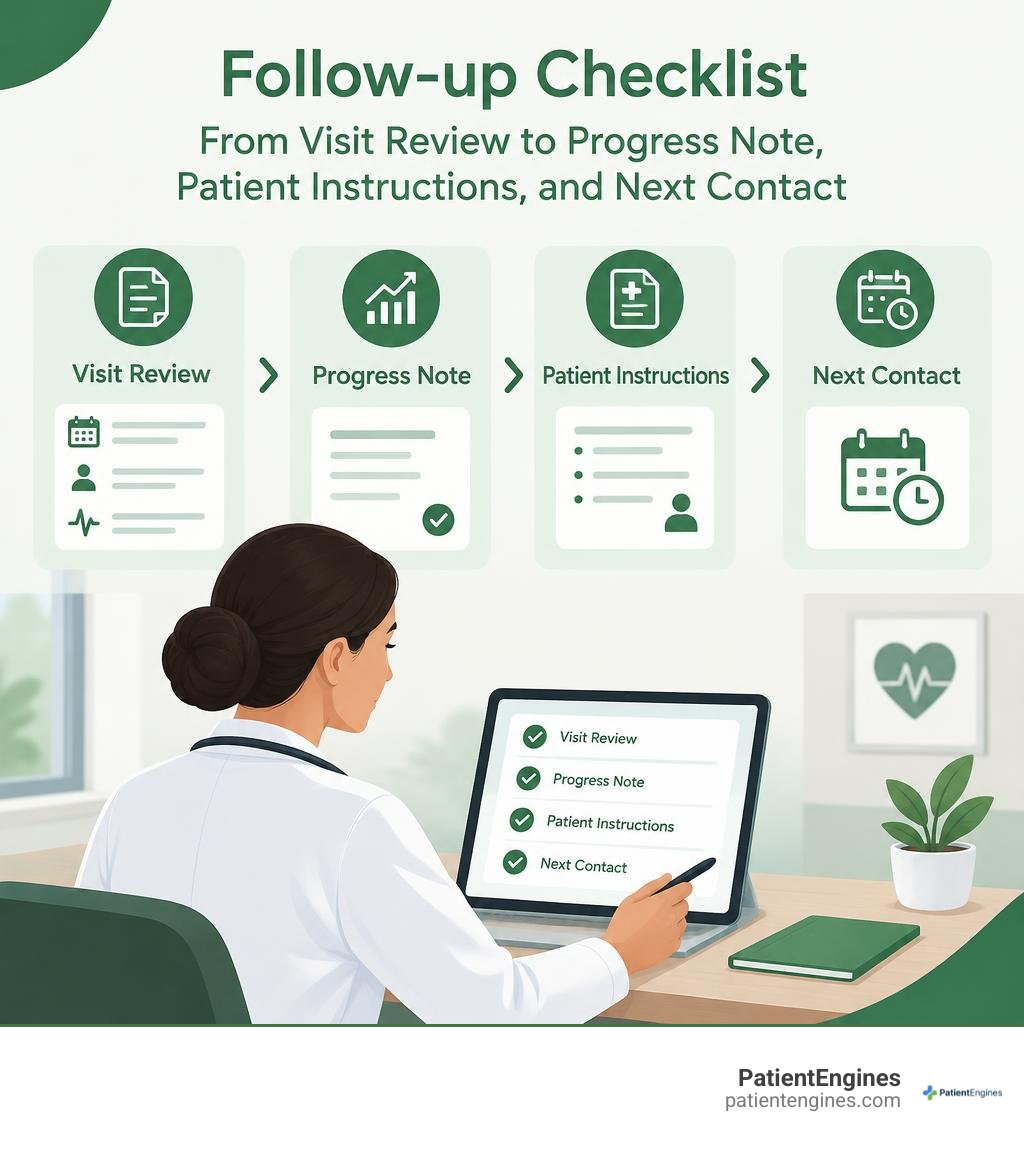
Core Anatomy of an Effective Medical Patient Follow Up Template
Clinical documentation accounts for up to 30% of a healthcare provider’s daily schedule. When administrative workloads pile up, clinicians often find themselves charting late into the evening. A standardized follow-up template acts as a structural guardrail, reducing manual data entry errors by up to 80% while establishing airtight medicolegal safety and continuity of care.
For medical practices, the primary challenge is striking the right balance between comprehensive clinical recording and operational efficiency. When staff spend less time navigating clunky interfaces or re-typing historical narratives, they can dedicate more energy to active patient care. For diverse medical and wellness practices navigating follow-up protocols, standardized templates eliminate guesswork, promote consistent data capture, and safeguard insurance reimbursements.
| Documentation Element | Initial Comprehensive Evaluation | Routine Follow-Up Progress Note |
|---|---|---|
| Primary Clinical Focus | Baseline diagnostic workup, complete medical/surgical history | Interval changes, treatment response, new/evolving symptoms |
| Encounter Length | Typically 30 to 60 minutes | Typically 10 to 20 minutes |
| History Documentation | Exhaustive review of systems, family and social histories | Targeted updates directly related to active clinical problems |
| Physical Exam Scope | Comprehensive multi-system physical examination | Problem-focused examination of relevant systems |
| Billing & Compliance | Establishes medical necessity and complex diagnostic baselines | Justifies ongoing treatment necessity and therapy adjustments |
| Care Plan Scope | Full initial management strategy and diagnostic workup | Adjustments, medication titrations, and next check-in window |
Essential Clinical Fields in a Medical Patient Follow Up Template
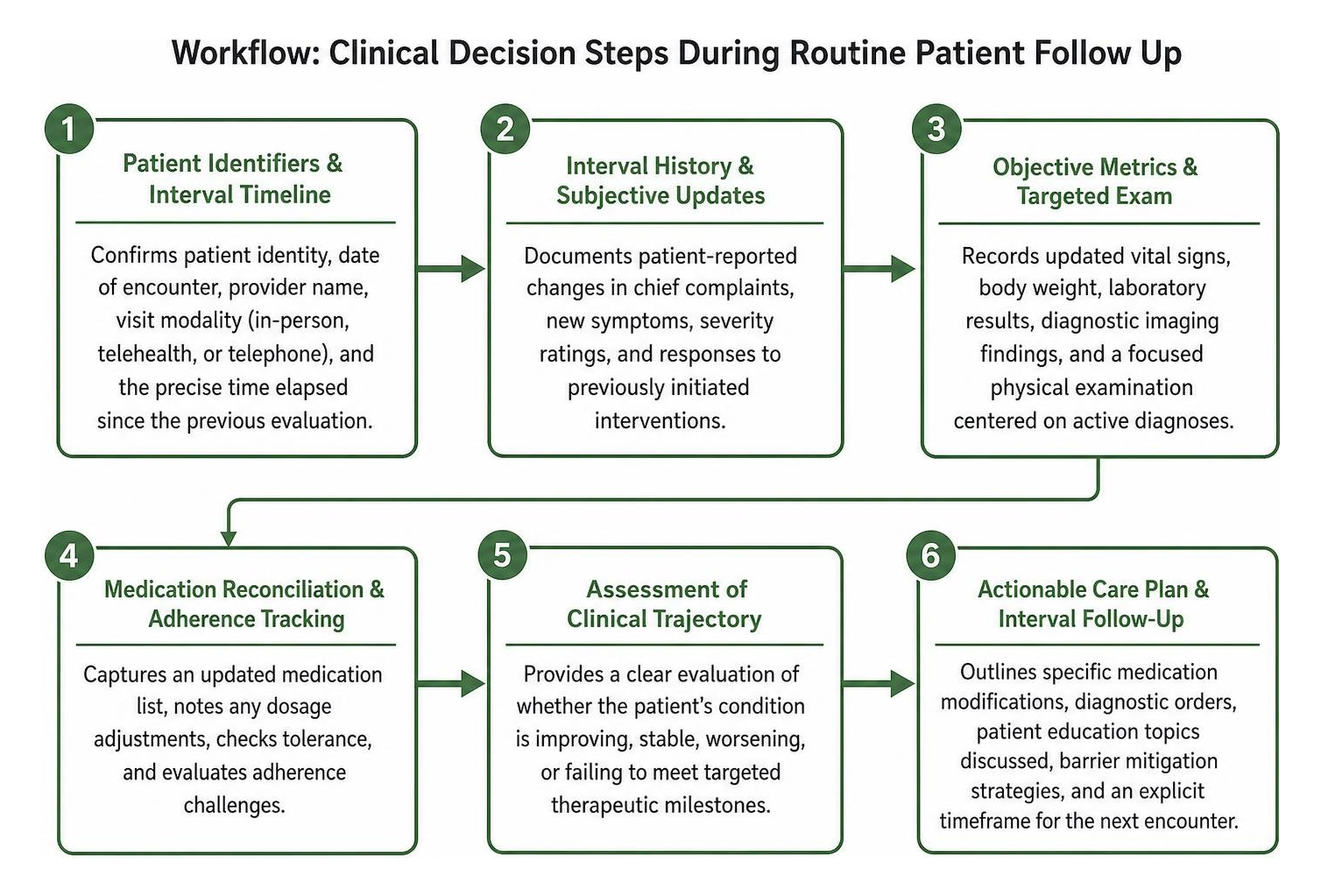
A well-structured checklist guides the provider through the encounter logically, ensuring no critical clinical data points fall through the cracks:
- Patient Identifiers & Interval Timeline: Confirms patient identity, date of encounter, provider name, visit modality (in-person, telehealth, or telephone), and the precise time elapsed since the previous evaluation.
- Interval History & Subjective Updates: Documents patient-reported changes in chief complaints, new symptoms, severity ratings (such as pain scales or functional scores), and responses to previously initiated interventions.
- Objective Metrics & Targeted Exam: Records updated vital signs, body weight, laboratory results, diagnostic imaging findings, and a focused physical examination centered on active diagnoses.
- Medication Reconciliation & Adherence Tracking: Captures an updated medication list, notes any dosage adjustments, checks tolerance, and evaluates adherence challenges.
- Assessment of Clinical Trajectory: Provides a clear evaluation of whether the patient’s condition is improving, stable, worsening, or failing to meet targeted therapeutic milestones.
- Actionable Care Plan & Interval Follow-Up: Outlines specific medication modifications, diagnostic orders, patient education topics discussed, barrier mitigation strategies, and an explicit timeframe for the next encounter.
Progress Notes vs. Initial Evaluations
One of the most frequent documentation missteps in clinical practice is “note bloat.” Providers often carry forward massive blocks of past medical history, social determinants, and extensive family background from the intake evaluation into routine follow-up encounters.
Follow-up encounters exist to document progress toward established goals. Carrying forward static historical details without clinical relevance creates noise, increases audit risks, and obscures real patient progress. While initial evaluation notes serve as the foundational baseline for diagnostic coding, a follow-up progress note must remain tight and focused on interval changes. Payers frequently scrutinize progress notes during coverage audits, and failing to show clear clinical reasoning for ongoing care is a leading cause of claim denials.
Top 5 Clinically Proven Follow-Up Checklists for Medical Practices
Deploying structured documentation frameworks allows clinical teams to maintain high standards of patient care while minimizing time spent behind computer screens. Below are five proven follow-up checklists designed for different clinical touchpoints.
Outpatient SOAP Progress Note Checklist
The SOAP (Subjective, Objective, Assessment, Plan) format remains the gold standard across outpatient ambulatory environments. It provides a standardized framework that allows any covering clinician to grasp a patient’s clinical status in seconds.
Clinicians can align their documentation workflows with established Progress Note Template standards by incorporating this structured checklist:
Post-Discharge Care Coordination Form
The transition from an inpatient hospital stay or surgical center back to the home environment represents a vulnerable window for patients. Structured post-discharge outreach plays a critical role in preventing adverse events, clarifying complex drug regimens, and keeping 30-day hospital readmission rates low.

Following evidence-based frameworks such as the AHRQ RED Toolkit documentation guidance, the post-discharge re-enforcement phone call should ideally occur within 72 hours of discharge. It is most effective when conducted by a licensed clinician, such as a nurse or pharmacist, who possesses strong medication expertise:
Patient-Facing After Visit Summary Template
Internal progress notes serve clinical, legal, and billing needs, but patients require clear, jargon-free instructions they can easily reference at home. Under CMS Promoting Interoperability standards, providing patients with an accessible clinical summary within three business days is an essential quality benchmark.
Using CMS-aligned After Visit Summary guidelines, clinics can convert complex medical encounters into an organized, single-page summary:
Specialty-Specific Checklists: Med Spas, Weight Loss, and Dental
Specialized practices require targeted checklists that capture their unique clinical metrics and treatment intervals.
1. Medical Aesthetics & Med Spas
- Pre-Treatment Baseline & Photography: Standardized clinical photographs (front, oblique, profile), informed consent review, and skin typing.
- Interval Assessment: Evaluation of post-procedure healing, assessment of erythema, edema, or bruising, and subjective satisfaction scores.
- Product Tracking: Precise documentation of neurotoxin units, dermal filler volume/lot numbers, anatomical injection sites, and laser energy settings.
- Post-Care & Review: Reinforcement of sun protection, activity restrictions, and scheduled 2-week touch-up windows.
2. Medical Weight Loss & Metabolic Health
- Body Composition Analytics: Interval weight, BMI, body fat percentage, visceral fat ratings, and waist circumference measurements.
- Medication Tolerance & Titration: Evaluation of GLP-1 receptor agonists or adjunct pharmacotherapy, gastrointestinal side effect screening, and dose titration schedule.
- Nutritional & Behavioral Progress: Daily protein targets, hydration volume, resistance training frequency, and appetite suppression levels.
- Laboratory Surveillance: Fasting glucose, HbA1c, lipid panel, and comprehensive metabolic monitoring schedules.
3. Dental & Oral Health
- Interval Periodontal Tracking: Full-mouth probing depths, bleeding on probing (BOP) percentages, and plaque indexing.
- Restorative & Occlusal Review: Assessment of restorations, wear patterns, bite alignment, and soft tissue pathology screenings.
- Home Hygiene Evaluation: Interdental cleaning adherence, brushing frequency, and prescribed antimicrobial rinse use.
- Recall Interval: Setting 3-, 4-, or 6-month hygiene maintenance cadences based on individualized periodontal risk.
Implementing and Automating Your Medical Patient Follow Up Workflows
Modern medical practices are moving away from manual charting and paper-based tracking sheets. Automating documentation through intelligent EHR templates, voice recognition, and modern digital platforms can reduce documentation time by up to 50%. This time savings helps clinical staff close encounter charts promptly rather than facing hours of after-hours paperwork.

Customizing a Medical Patient Follow-Up Template for Your EHR
To maximize efficiency, follow-up templates should integrate smoothly with your practice’s electronic health record (EHR) and patient communication workflows. Many modern practices adopt specialized solutions like automated patient management services to streamline intake, appointment reminders, and post-visit communications within a single, cohesive workflow.
Key setup strategies include:
- Dynamic Data Sync: Ensure your template auto-populates baseline demographics, allergy lists, and recent lab results directly from the chart, preventing redundant data entry.
- Conditional Logic Fields: Build dynamic templates where specialized sub-sections (such as wound care checks or titration tables) only appear when triggered by specific clinical selections.
- Dot Phrases & Text Expanders: Set up standardized macros for recurring counseling topics, normal review-of-systems findings, and standard post-procedure discharge instructions.
- Integrated Patient Portals: Automatically convert internal plan elements into secure, readable after-visit summaries delivered directly to the patient’s mobile device.
Objective Documentation: Handling Non-Adherence and Stalled Progress
Documenting treatment hurdles, lack of improvement, or non-adherence requires objective, non-judgmental language. Subjective or critical phrasing in a medical chart can compromise the therapeutic alliance and create legal vulnerabilities.
When clinical progress stalls:
- Document Objective Metrics: Quantify the lack of progress using tangible markers (e.g., lab values, range-of-motion degrees, wound measurements).
- Explore Underlying Barriers: Record patient-reported explanations, financial challenges, or social determinants of health affecting their care plan.
- Note Clinical Pivot Strategies: Clearly outline adjusted differentials, new diagnostic testing ordered, medication titrations, and a defined timeline for reassessment.
Frequently Asked Questions About Patient Follow-Up Documentation
How detailed should follow-up notes be compared to initial evaluation notes?
Follow-up notes should be significantly more concise than initial evaluation notes. While initial evaluations require a complete medical history, full review of systems, and baseline physical exam to establish care, follow-up notes should focus strictly on interval changes since the last visit. Emphasize treatment responses, new or changing symptoms, focused exam findings, and care plan modifications. Repeating stable, unchanging historical data adds clutter and increases audit risks.
How do you document when a patient shows no improvement?
When a patient fails to progress toward clinical goals:
- Document the lack of improvement objectively using measurable data (e.g., pain scores, functional tests, lab values).
- Detail potential barriers to recovery, including treatment tolerance, physiological factors, or adherence challenges.
- Re-evaluate the differential diagnosis and document your clinical reasoning.
- Record all updates to the treatment plan, such as ordering advanced diagnostic imaging, adjusting medication dosages, referring to a specialist, and setting a firm re-evaluation date.
What are the legal and HIPAA requirements for follow-up templates?
Follow-up templates and communication channels must comply with HIPAA Privacy and Security Rules:
- All digital templates, whether housed in an EHR, cloud form builder, or spreadsheet, must be stored in an encrypted environment with role-based access controls and comprehensive audit logging.
- Patient communications (such as emails or SMS follow-ups) should utilize secure, HIPAA-compliant platforms with signed Business Associate Agreements (BAAs) in place.
- Adhere strictly to the “minimum necessary” standard by including only the health information essential to the follow-up encounter.
- Ensure all clinical notes are authenticated, signed, and dated within the required regulatory timeframe (typically within 24 to 48 hours of the visit).
Conclusion
Standardized clinical checklists do more than streamline medical charting, they serve as the backbone of high-quality patient care and operational efficiency. By replacing unstructured, free-form charting with targeted follow-up templates, healthcare practices can reduce documentation burden, improve patient outcomes, and prevent administrative burnout.
Whether you run a medical wellness clinic, an aesthetic practice, or a multi-provider center, maintaining consistent, professional patient follow-ups is key to long-term patient retention and practice growth. To discover how our single embedded team can elevate your practice workflows and patient journey, explore our end-to-end practice growth platform to scale your business with measurable, HIPAA-compliant systems.